Lesson 9 of 9 · Intermediate · 20 min
Barre chords without the struggle
Why F is hard, how to make it ring, and how two shapes unlock every major and minor chord on the neck.
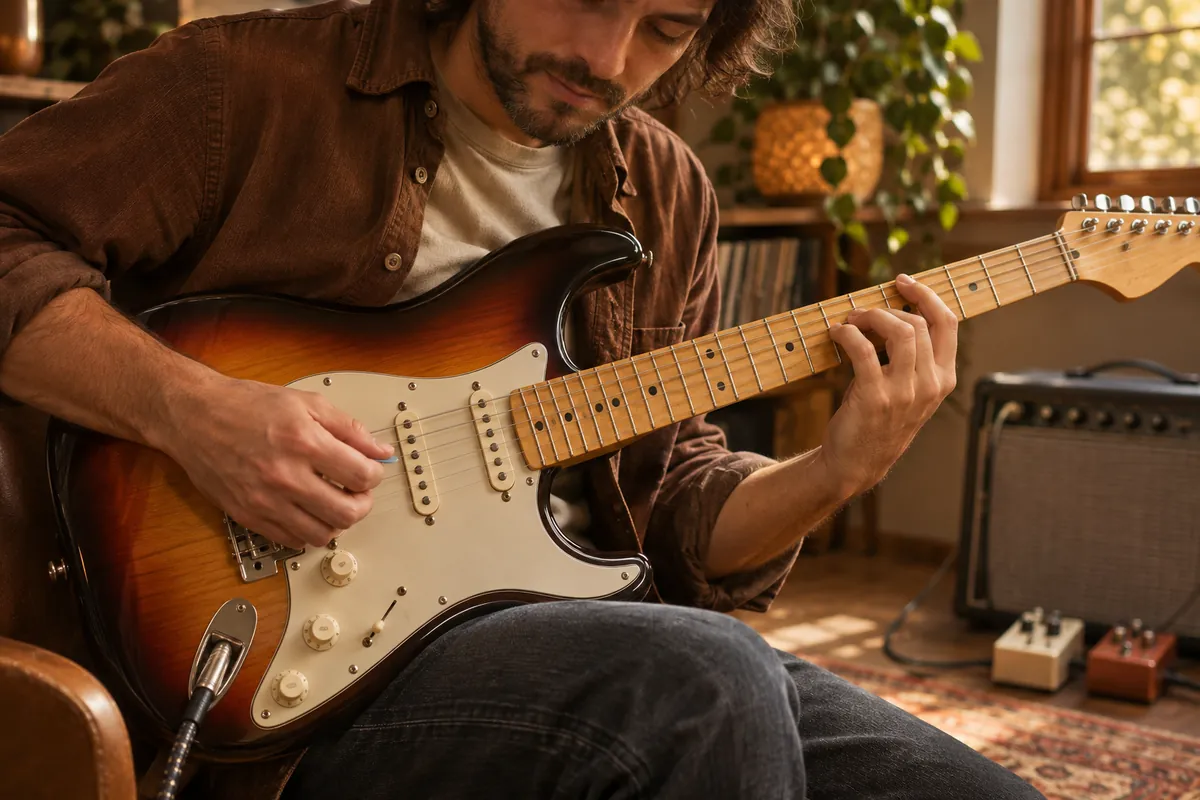
The F chord is famous for making new players want to quit. A barre chord means one finger presses all (or most) of the strings at once. It's hard at first, but once you get it, two shapes let you play any major or minor chord anywhere on the neck.
It's technique, not strength
- Roll the index finger slightly onto its bony outer edge. The soft underside lets strings slip into the creases.
- Move the barre right behind the fret. The closer it is, the less pressure you need.
- Pull back with your arm instead of squeezing with your thumb. Let the weight of your arm do the work.
- Thumb lower, roughly behind your middle finger, in the middle of the neck.
- Check your setup. High string action makes barre chords much harder. A guitar tech can lower it.
Build it in steps
- Barre just the top two strings at the 1st fret. Make them ring.
- Add the rest of the F shape (fingers 2, 3 and 4) without the barre: that's an E shape moved up a fret.
- Combine them, and pick each string to find the ones that buzz. Adjust one at a time.
- Practice 2–3 minutes a day. Barre chords are a matter of weeks, not days.
Two shapes, every chord
The E-shape barre (like F) takes its name from the note under your index finger on the 6th string. Barre at the 3rd fret and it's G; at the 5th fret, it's A. The A-shape barre (like Bm) is named from the 5th string. Learn the notes on those two strings and you can find any chord.
| Fret | 1 | 3 | 5 | 7 | 8 | 10 |
|---|---|---|---|---|---|---|
| 6th string (E shape) | F | G | A | B | C | D |
| 5th string (A shape) | A#/B♭ | C | D | E | F | G |
Until F comes easily, use Fmaj7 from the chord library. It fits in most songs and sounds lovely.
Updated November 19, 2026.